News
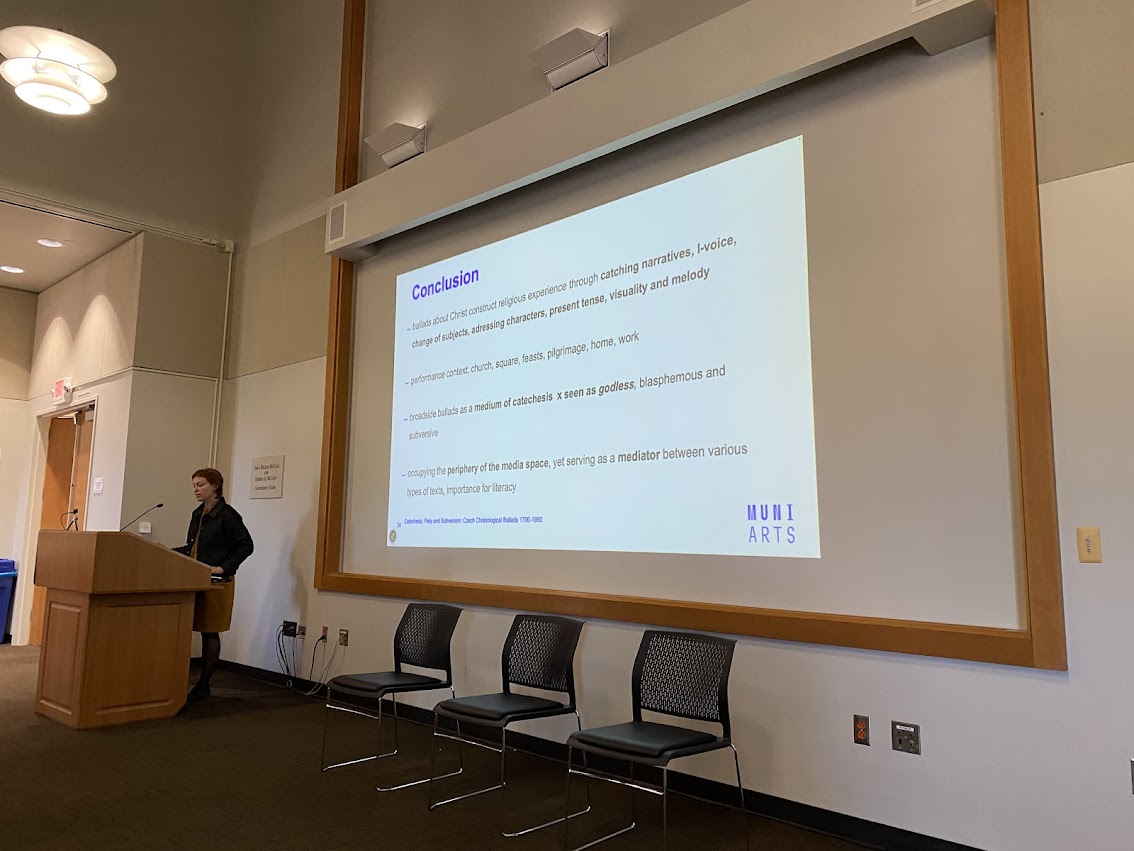
Our research team member Marie Hanzelková gave a presentation on May 30 at the conference “Performing Religion in Early Modern England,” organized by the Early Modern Center at the University of California, Santa Barbara. In her paper titled “Catechesis, Piety, and Subversion: Czech Christological Ballads (1700–1950),” she introduced the project and its goals to an international scholarly audience.
Catechesis, Piety, and Subversion: Czech Christological Ballads (1700–1950)
While Marian themes dominated Czech broadside ballads, Christological motifs also played a significant role. The vast corpus of surviving songs offers a diverse range of perspectives on Jesus Christ, covering canonical and apocryphal narratives, pilgrimage traditions, liturgical practices, and mystical devotion. Some ballads, shaped by long-standing traditions, reflect forms of piety that evolved over centuries.
This paper examines Christological ballads with dramatic potential, whether through documented performances or inherent theatricality. Even in cases where direct evidence of performance is lacking, many of these songs possess a strong dramatic quality—whether in their narrative structure (often centered on Passion or apocryphal themes), their formal elements (dialogue, character monologues), or a combination of both. Additionally, visual aspects such as typography, illustrations, and picture boards contribute to their performative nature.
Finally, the paper explores the songs’ function and reception. Positioned ambiguously between official and heterodox expression, these ballads both reinforced Catholic doctrine and, at times, contained subversive elements deemed blasphemous by the authorities. This tension reflects their fluid position within the broader media landscape, operating at the intersection of scripturality and orality.